ADVANCED TECHNOLOGIES ACADEMY

Build Technology Systems That Work in the Real World.

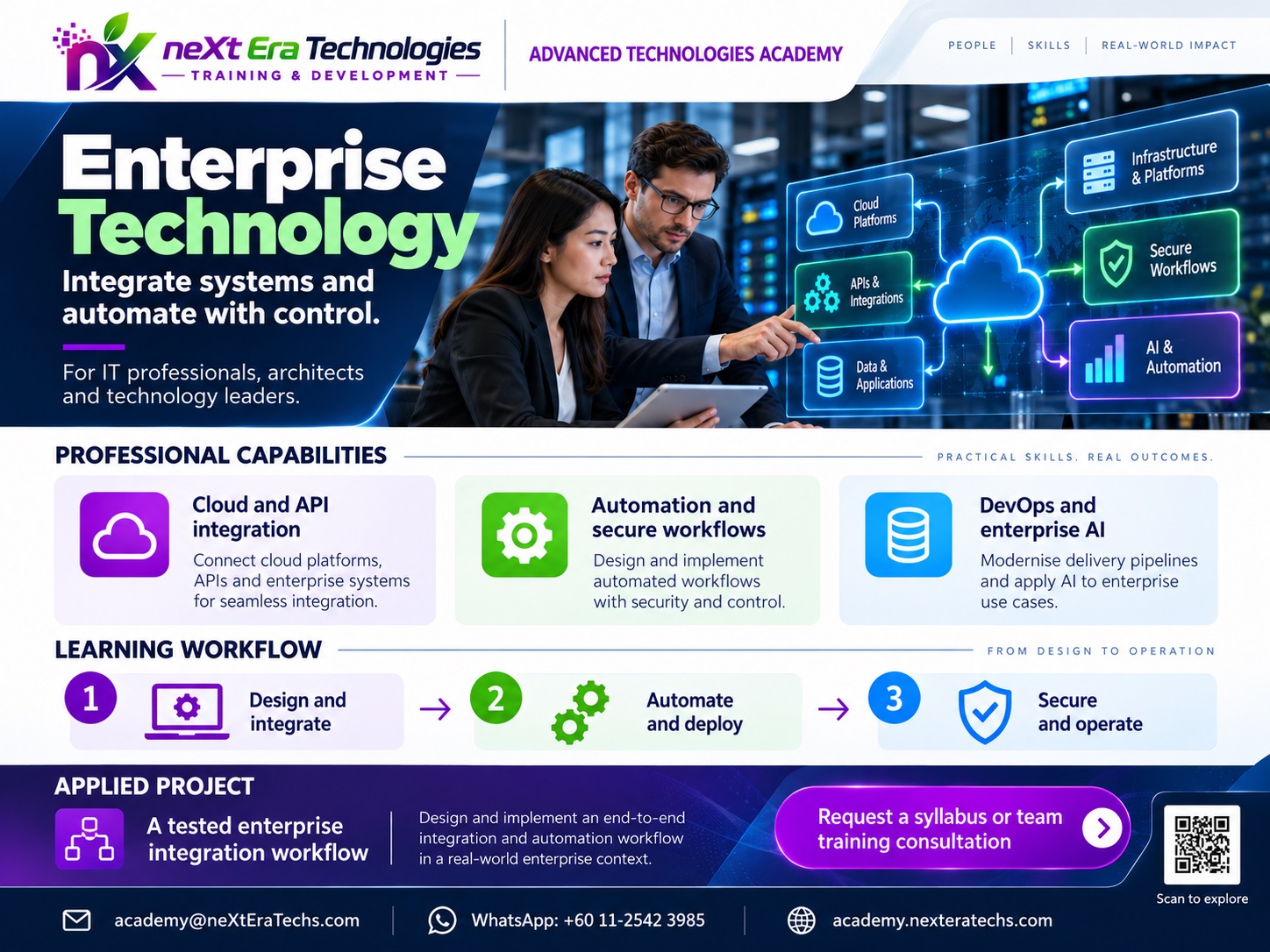
Learn how cloud platforms, enterprise applications, APIs, databases, automation, cybersecurity and AI come together to create reliable technology systems.

ENTERPRISE TECHNOLOGY

From Individual Applications to Connected Systems

Modern organizations depend on interconnected software, databases, cloud services, APIs, identity systems, networks and automated workflows.

Enterprise technology training teaches students how these components fit together and how to design systems that are secure, observable, maintainable and scalable.

The pathway connects software development with cloud computing, integration, automation, enterprise data and applied AI.

LEARN

Understand enterprise architectures, platforms, applications and infrastructure.

BUILD

Develop applications, APIs, integrations, workflows and cloud-based services.

APPLY

Design technology solutions around real organizational requirements.

Explore the curriculum

Inside Enterprise Technology

Nine progressive technical modules, connecting software fundamentals with infrastructure, secure integrations, automation and enterprise AI.

09 technical modulesFoundation to advanced application

The module activities, entry knowledge and project examples are illustrative. Scope, duration, assessment and delivery requirements should be confirmed for each course offering.

MODULE 01 ENTERPRISE TECHNOLOGY

Software Engineering Foundations

Learn core development practices, maintainable code and software design.

6 curriculum topics · Applied project example

01 Curriculum focus

  • Programming fundamentals
  • Data structures
  • Object-oriented concepts
  • Version control
  • Testing fundamentals
  • Software architecture
Suggested entry knowledge

Basic computer literacy and logical problem-solving; programming is introduced progressively.

02 Practical learning outcomes

  1. Explain and apply the key concepts of software engineering foundations.
  2. Complete a guided technical exercise using relevant tools.
  3. Test, document and review the resulting work.
APPLIED PROJECT IDEA

Version-Controlled Service

Create a small tested application with a documented architecture and Git history.
MODULE 02 ENTERPRISE TECHNOLOGY

APIs & Integration

Connect services with documented interfaces, secure requests and robust error handling.

6 curriculum topics · Applied project example

01 Curriculum focus

  • REST APIs
  • HTTP fundamentals
  • JSON and structured data
  • Authentication
  • API integration
  • Error handling
Suggested entry knowledge

Programming fundamentals, HTTP concepts and basic JSON.

02 Practical learning outcomes

  1. Explain and apply the key concepts of apis & integration.
  2. Complete a guided technical exercise using relevant tools.
  3. Test, document and review the resulting work.
APPLIED PROJECT IDEA

Reliable API Connector

Build an API integration with input validation, authentication handling and error tests.

MODULE 03 ENTERPRISE TECHNOLOGY

Databases & Enterprise Data

Organize enterprise information with relational models, queries and data integrity.

6 curriculum topics · Applied project example

01 Curriculum focus

  • Relational databases
  • SQL
  • Data modelling
  • Transactions
  • Data integration
  • Data governance concepts
Suggested entry knowledge

Basic programming, data types and introductory SQL.

02 Practical learning outcomes

  1. Explain and apply the key concepts of databases & enterprise data.
  2. Complete a guided technical exercise using relevant tools.
  3. Test, document and review the resulting work.
APPLIED PROJECT IDEA

Transactional Data Service

Design a relational schema and implement queries with transaction and data-integrity checks.

MODULE 04 ENTERPRISE TECHNOLOGY

Cloud Computing

Understand cloud resources, networking, identities and secure service deployment.

6 curriculum topics · Applied project example

01 Curriculum focus

  • Cloud service models
  • Compute and storage
  • Networking fundamentals
  • Managed databases
  • Identity and access
  • Cloud architecture
Suggested entry knowledge

Basic networking, operating systems and command-line familiarity.

02 Practical learning outcomes

  1. Explain and apply the key concepts of cloud computing.
  2. Complete a guided technical exercise using relevant tools.
  3. Test, document and review the resulting work.
APPLIED PROJECT IDEA

Cloud Service Deployment

Deploy a sample service using role-based access, logging and documented network settings.

MODULE 05 ENTERPRISE TECHNOLOGY

DevOps & Automation

Automate builds, tests, deployments and operational monitoring.

6 curriculum topics · Applied project example

01 Curriculum focus

  • CI/CD concepts
  • Build automation
  • Deployment workflows
  • Containers
  • Infrastructure automation
  • Monitoring and logging
Suggested entry knowledge

Git, basic testing, command line and deployment fundamentals.

02 Practical learning outcomes

  1. Explain and apply the key concepts of devops & automation.
  2. Complete a guided technical exercise using relevant tools.
  3. Test, document and review the resulting work.
APPLIED PROJECT IDEA

Automated Delivery Pipeline

Create a version-controlled build, test and deployment workflow with rollback notes.

MODULE 06 ENTERPRISE TECHNOLOGY

Enterprise Architecture

Design dependable, interconnected platforms with explicit system boundaries.

6 curriculum topics · Applied project example

01 Curriculum focus

  • System architecture
  • Service-oriented design
  • Event-driven systems
  • Distributed systems
  • Scalability
  • Reliability engineering
Suggested entry knowledge

APIs, databases, networking and cloud fundamentals.

02 Practical learning outcomes

  1. Explain and apply the key concepts of enterprise architecture.
  2. Complete a guided technical exercise using relevant tools.
  3. Test, document and review the resulting work.
APPLIED PROJECT IDEA

Enterprise Integration Blueprint

Document a multi-service architecture, reliability goals and failure recovery paths.

MODULE 07 ENTERPRISE TECHNOLOGY

Cybersecurity Foundations

Protect applications, services, identities and secrets throughout development.

6 curriculum topics · Applied project example

01 Curriculum focus

  • Security principles
  • Authentication
  • Authorization
  • Secrets management
  • Secure APIs
  • Threat awareness
Suggested entry knowledge

HTTP, networking, authentication concepts and basic programming.

02 Practical learning outcomes

  1. Explain and apply the key concepts of cybersecurity foundations.
  2. Complete a guided technical exercise using relevant tools.
  3. Test, document and review the resulting work.
APPLIED PROJECT IDEA

Secure Service Review

Apply least privilege, secrets handling and a basic threat model to an API-backed service.

MODULE 08 ENTERPRISE TECHNOLOGY

Enterprise Automation

Connect business processes through integration, events and operational controls.

6 curriculum topics · Applied project example

01 Curriculum focus

  • Workflow automation
  • Business processes
  • System integration
  • Event triggers
  • Exception handling
  • Operational monitoring
Suggested entry knowledge

APIs, databases, event handling and basic programming.

02 Practical learning outcomes

  1. Explain and apply the key concepts of enterprise automation.
  2. Complete a guided technical exercise using relevant tools.
  3. Test, document and review the resulting work.
APPLIED PROJECT IDEA

Event-Driven Workflow

Prototype an automated process with retries, exception routing and audit records.

MODULE 09 ENTERPRISE TECHNOLOGY

Enterprise AI

Integrate AI capabilities into enterprise applications with safeguards and evaluation.

6 curriculum topics · Applied project example

01 Curriculum focus

  • AI application architecture
  • LLM integrations
  • RAG systems
  • AI APIs
  • Agent workflows
  • AI evaluation and controls
Suggested entry knowledge

Python or another programming language, APIs, data protection and testing fundamentals.

02 Practical learning outcomes

  1. Explain and apply the key concepts of enterprise ai.
  2. Complete a guided technical exercise using relevant tools.
  3. Test, document and review the resulting work.
APPLIED PROJECT IDEA

Enterprise Knowledge Assistant

Connect an AI component to approved data; evaluate groundedness, access boundaries and failure cases.

TECHNOLOGY STACK

The Enterprise Technology Stack

Students learn to think across the complete system rather than treating applications, infrastructure and data as isolated components.

Applications

  • Web Applications
  • Backend Services
  • Python
  • JavaScript / TypeScript
  • APIs
  • Microservices Concepts

Platforms & Cloud

  • Cloud Computing
  • Containers
  • Virtual Machines
  • Object Storage
  • Managed Databases
  • Cloud Networking

Data & Intelligence

  • SQL Databases
  • Data Pipelines
  • Analytics
  • Machine Learning
  • LLM Applications
  • Enterprise AI

Operations & Security

  • CI/CD
  • Monitoring
  • Logging
  • Identity
  • Access Control
  • Security Controls
Hands-on Projects

Build Systems, Not Just Applications

Students work through projects that connect application development with data, infrastructure, automation and operations.

Project 01 · AI & Integration

Enterprise AI Application

Build an AI-enabled application that connects a user interface, backend service, enterprise data and an AI component.

  • Application architecture
  • API integration
  • Database connection
  • LLM integration
  • Authentication
  • Evaluation and logging
Suggested deliverable: An authenticated application prototype with an AI-enabled workflow, documented tests and operational logs.
Project 02 · Cloud & Data

Cloud Data Platform

Design a cloud-based data workflow that ingests, stores and processes information for downstream analytics.

  • Data ingestion
  • Cloud storage
  • Database design
  • Data transformation
  • Access controls
  • Monitoring
Suggested deliverable: A reproducible ingestion-to-transformation pipeline with role-based permissions, data checks and monitoring.
Project 03 · Process Automation

Automated Business Workflow

Build an integrated workflow that connects multiple systems and automatically processes routine business operations.

  • Process definition
  • API integration
  • Event triggers
  • Validation rules
  • Exception handling
  • Operational logging
Suggested deliverable: An event-triggered workflow demonstration with validation, failure handling and an auditable event log.

Illustrative project deliverables; actual scope, services, credentials and assessments depend on the course offering.

LEARNING JOURNEY

Progress from Software Foundations to Enterprise Systems

Level 01

Software Foundations

Level 02

APIs & Databases

Level 03

Cloud & DevOps

Level 04

Enterprise Architecture

Level 05

Intelligent Enterprise Systems

LEARNING OUTCOMES

What Students Will Be Able to Do

✓ Explain the major components of enterprise technology systems.
✓ Design basic application architectures.
✓ Develop and consume REST APIs.
✓ Work with relational databases and SQL.
✓ Explain fundamental cloud computing concepts.
✓ Deploy basic services using modern development workflows.
✓ Use version control and automated testing practices.
✓ Understand containers and deployment concepts.
✓ Design basic system integrations.
✓ Implement basic authentication and access controls.
✓ Connect AI capabilities to enterprise applications.
✓ Document architecture, dependencies and operational boundaries.
PRACTICAL SKILLS

Technical Skills

Python JavaScript TypeScript REST APIs HTTP SQL Databases Cloud Computing Containers Git CI/CD Automation System Integration Monitoring Cybersecurity Enterprise AI
RESPONSIBLE TECHNOLOGY

Build Systems That Can Be Trusted

Enterprise systems must account for security, reliability, data protection, operational visibility and clear system boundaries.

Security

Apply secure development, authentication, authorization and secrets-management principles.

Reliability

Consider failure modes, availability, recovery and system dependencies.

Privacy

Protect sensitive information and understand appropriate data-access boundaries.

Observability

Use logs, metrics and monitoring to understand system behavior and failures.

Governance

Document ownership, dependencies, controls, assumptions and operational responsibilities.

DEVELOPMENT WORKFLOW

From Requirement to Reliable System

Students follow a structured engineering workflow that connects requirements, architecture, implementation, testing and operations.

  1. 01

    DEFINE

    Identify requirements, constraints, stakeholders and acceptance criteria.

  2. 02

    ARCHITECT

    Design system components, data flows, interfaces and technology choices.

  3. 03

    DEVELOP

    Implement services, applications and infrastructure configurations.

  4. 04

    INTEGRATE

    Connect systems through APIs, messaging and data interfaces.

  5. 05

    TEST

    Verify functional behavior, reliability and performance.

  6. 06

    SECURE

    Assess vulnerabilities, access controls, secrets and security requirements.

  7. 07

    DEPLOY

    Release validated components using controlled deployment workflows.

  8. 08

    MONITOR

    Observe health, performance, incidents and operational reliability.

WHO SHOULD ATTEND

Built for Future Technology Professionals

  • Students
  • Computer Science Students
  • Software Engineering Students
  • Information Technology Students
  • Engineering Students
  • Technology Professionals
  • Software Developers
  • System Administrators
  • Data and AI Professionals
  • Educators and Institutions
PREREQUISITES

Build the Foundations First

Foundation programs require basic computer literacy, logical reasoning and familiarity with common software applications.

Programming programs benefit from basic programming concepts and problem-solving skills.

Advanced cloud, DevOps and architecture projects require programming, networking, databases and command-line fundamentals.

FOR SCHOOLS & INSTITUTIONS

Bring Enterprise Technology Into the Classroom

Programs can be adapted for schools, universities, technical institutions and professional development.

Software Engineering Workshops
Cloud Computing Programs
API & Integration Bootcamps
DevOps & Automation Programs
Enterprise AI Programs
Cybersecurity Foundations
System Architecture Workshops
Faculty Development
Custom Institutional Programs
APPLICATIONS

Where Enterprise Technology Skills Are Applied

Enterprise Software
Cloud Applications
Business Automation
Enterprise AI
Data Platforms
System Integration
Digital Transformation
Smart Industry
Financial Technology
Government Technology
Education Technology
Operational Systems
FINAL PROJECT

Build Your Own Enterprise Technology System

From Business Requirement to Working System

Students complete an applied engineering project that connects software, data, APIs, infrastructure, security and operational requirements.

  • Define a real operational requirement
  • Identify users and system boundaries
  • Design the system architecture
  • Design the data model
  • Develop application components
  • Build API integrations
  • Implement authentication and authorization
  • Connect databases or enterprise data
  • Add automation or AI where appropriate
  • Test system behavior
  • Document security and failure conditions
  • Deploy and demonstrate the system

Build the Skills to Shape the Next Era

Learn how software, cloud, data, automation and AI can come together to create reliable enterprise systems.

VISIT THE ACADEMY