Digital Transformation Foundations
CORE TECHNICAL TOPICS
- Digital maturity and readiness
- Business challenges and measurable outcomes
- Transformation strategy and roadmaps
- Digital business models and customer journeys
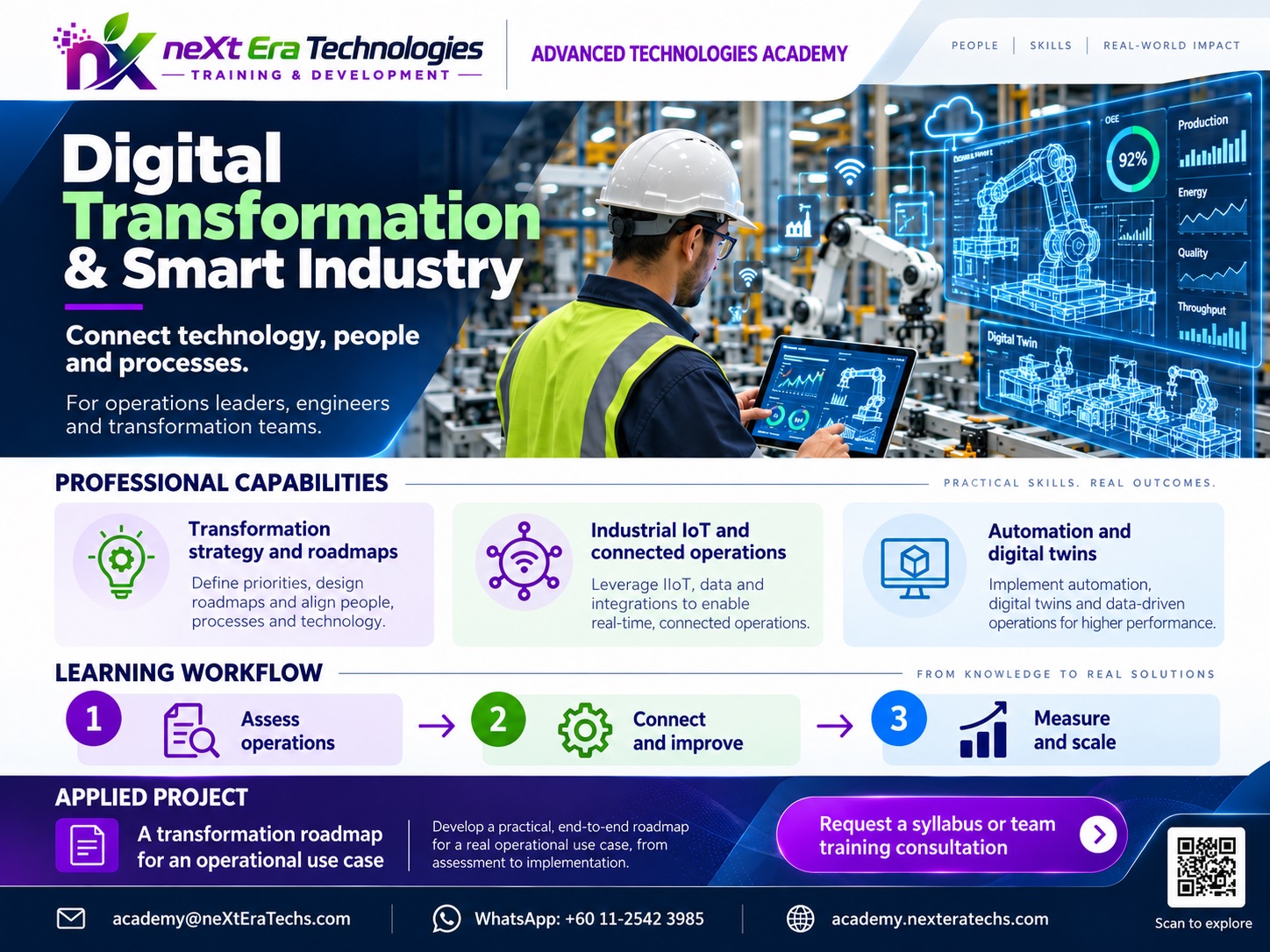
Learn how digital strategy, connected industrial systems, automation and artificial intelligence can improve the way organizations and industrial operations work.
Digital transformation connects organizational goals with better processes, measurable performance and technology that people can use. Smart Industry applies this approach to factories, utilities, warehouses and industrial assets.
Explore how businesses assess digital maturity, plan transformation, connect industrial equipment, interpret operational data and turn technical findings into practical decisions.
Explore the business and technical foundations behind successful digital transformation and smarter industrial systems.
CORE TECHNICAL TOPICS
Follow information from business requirements and industrial equipment through connectivity, analysis and operational decisions.
Set priorities, baselines, constraints and measures of success.
Understand sensors, control systems, data flows and operational technology.
Measure losses, assess reliability and apply analytics or AI where appropriate.
Plan interventions, track results and support people using new systems.
Continuous improvement: Measurements and operational feedback can inform new goals, refined data collection and better interventions.
Work with simulated business and plant data to investigate real operational questions and justify your recommendations.
Assess an organization's digital maturity, choose improvement priorities and prepare a roadmap with ownership, targets and adoption measures.
Use simulated machine-state and production records to calculate OEE, identify bottlenecks and analyze the causes of downtime or scrap.
Explore industrial sensor readings and equipment events to design a data workflow for condition monitoring and maintenance decisions.
Explain digital transformation and Industry 4.0 concepts in a business context.
Assess opportunities for process improvement and digital adoption.
Define operational KPIs, baselines and benefits-tracking measures.
Map core components of an industrial IoT data flow.
Interpret OEE and equipment performance information.
Recognize suitable uses and limits of industrial AI and digital twins.
Identify OT security, safety and data-quality considerations.
Present a practical, evidence-supported improvement plan.
The pathway builds conceptual knowledge first, then moves into connected systems, applied analytics and transformation design.
Digital transformation, Industry 4.0, operations and industrial-system fundamentals.
Business processes, industrial IoT, data collection, KPIs and production performance.
Automation strategies, monitoring workflows, reliability analysis and AI applications.
Design an integrated transformation or smart-industry solution and evaluate its value.
A suggested progression of learning activities; individual delivery requirements and assessments depend on the program.
Industrial change requires careful attention to safety, availability, people, security and the quality of decisions.
Recognize how operational technology differs from office IT and why industrial networks require appropriate security practices, including IEC 62443 concepts.
Define metrics consistently, validate data sources and document assumptions before making performance or AI claims.
Involve operators and employees, test changes before expanding them and compare actual outcomes with original targets.
Improve production performance, quality inspection and equipment reliability.
Monitor critical assets, energy use and operational conditions.
Analyze process flow, connected assets and operational efficiency.
Plan organization-wide digital initiatives and track business value.
Support asset management with condition monitoring and reliability analysis.
Assess energy performance and opportunities to reduce operational losses.
Foundation: Basic computer literacy and an interest in business processes or industrial technology.
Advanced applications: Familiarity with industrial operations, data analysis or the relevant foundation topics is recommended.
Different activities can be adapted to technical and nontechnical participants. Individual advanced-course prerequisites require confirmation before enrollment.
Programs can be organized around the needs of leadership groups, engineers, operational teams and institutions.
Focused introductions to digital transformation, industrial connectivity and smart operations.
Guided business cases and simulated industrial labs tailored to team responsibilities.
Progressive training aligned to existing skills, equipment context and organizational priorities.
Training exercises described here use fictional organizations and simulated industrial datasets. Specific delivery formats, prerequisites and certification requirements should be confirmed when a program is scheduled.
Swipe on mobile or use the arrows and dashes. Select a program to register on the Training Registration page.