Advanced Technologies Academy

Build Intelligent Systems That Think, Reason and Act

Learn how modern AI applications combine large language models, data, tools, APIs and intelligent workflows to solve practical problems.

Modern AI Engineering

From AI Concepts to Working Intelligent Systems

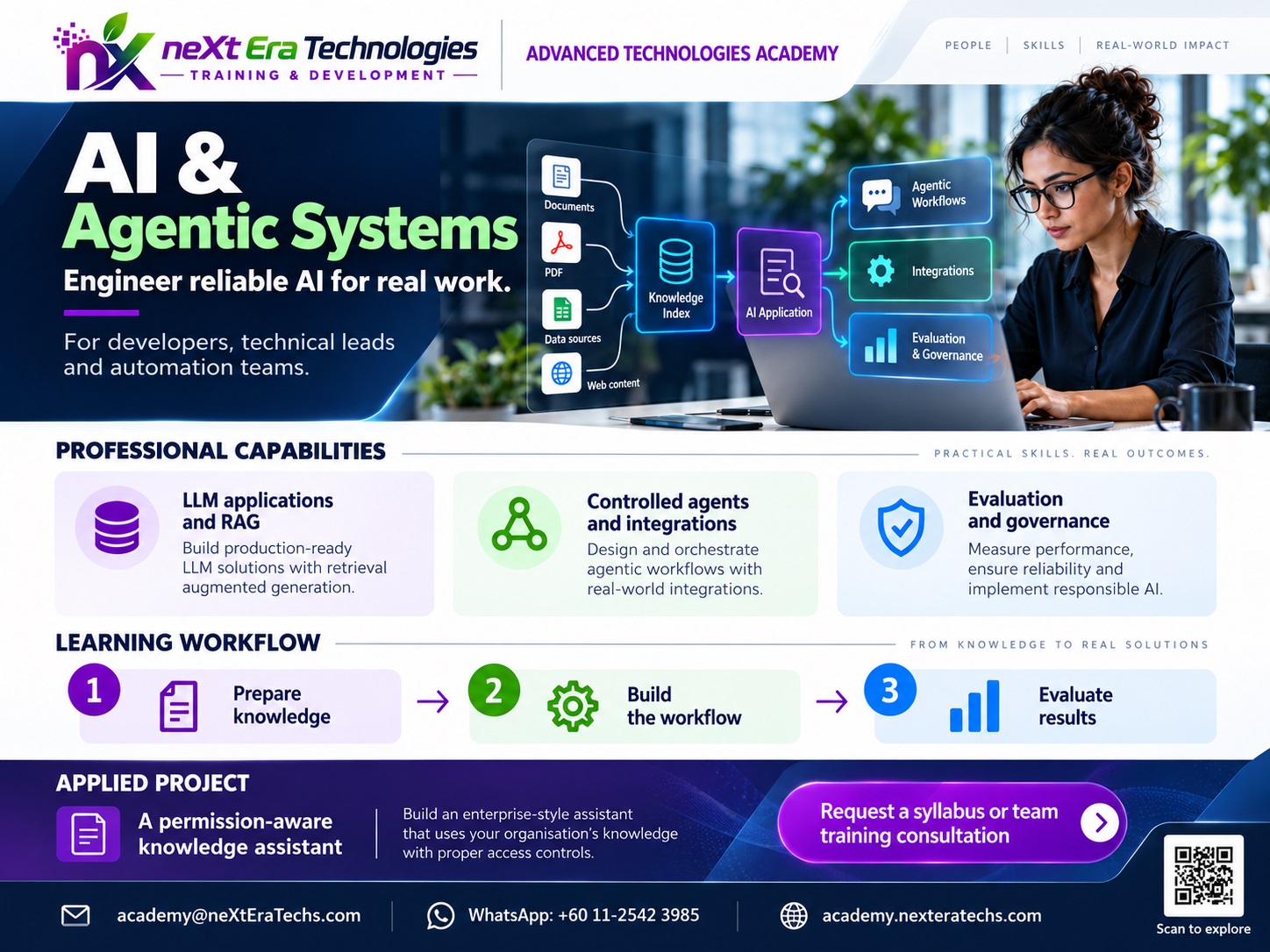
Artificial intelligence is moving beyond systems that simply generate responses. Modern AI applications can retrieve information, use external tools, interact with databases and APIs, execute structured workflows and coordinate multiple specialized tasks.

01

Learn

Understand AI concepts, architectures and technical principles.

02

Build

Develop working AI applications and agent workflows.

03

Apply

Use AI technologies to solve defined real-world problems.

Curriculum

Explore the AI & Agentic Systems Curriculum

Six technical modules covering AI foundations, LLM applications, agents, engineering, retrieval, and responsible AI development.

Illustrative modules and applied projects are shown below. Exact scope, required software, duration, assessments and credentials depend on the specific course offering.

MODULE 01 · AI ENGINEERING

AI Foundations

Understand machine learning concepts and the technical building blocks of modern AI applications.

6 curriculum themes · 1 illustrative project

01 / Curriculum focus

  • Artificial intelligence concepts
  • Machine learning fundamentals
  • Neural networks
  • Generative AI
  • Large language models
  • Embeddings and vector search
Suggested entry knowledge

Computer literacy, mathematical reasoning and a willingness to learn technical concepts.

02 / Applied practice

  1. Complete guided exercises and document the results.
  2. Test representative success and failure cases.
  3. Explain assumptions, limitations and improvements.
APPLIED PROJECT IDEA

Explore and compare AI model outputs

Document model capabilities, errors and limitations using a structured test set.
MODULE 02 · AI ENGINEERING

Generative AI & LLM Applications

Build applications with language models, prompts, structured outputs and API integration.

6 curriculum themes · 1 illustrative project

01 / Curriculum focus

  • LLM concepts
  • Prompt design
  • Structured outputs
  • Embeddings
  • Semantic search
  • LLM APIs
Suggested entry knowledge

Python basics, JSON, HTTP requests and API concepts.

02 / Applied practice

  1. Complete guided exercises and document the results.
  2. Test representative success and failure cases.
  3. Explain assumptions, limitations and improvements.
APPLIED PROJECT IDEA

Create a structured LLM-powered application

Implement API calls, schema validation, basic tests and documented error cases.

MODULE 03 · AI ENGINEERING

AI Agents

Design controlled agent workflows with task planning, tool use and state management.

6 curriculum themes · 1 illustrative project

01 / Curriculum focus

  • Agent concepts
  • Task decomposition
  • Tool use
  • Memory and context
  • Agent workflows
  • Multi-agent architectures
Suggested entry knowledge

Python, APIs, program control flow and structured LLM calls.

02 / Applied practice

  1. Complete guided exercises and document the results.
  2. Test representative success and failure cases.
  3. Explain assumptions, limitations and improvements.
APPLIED PROJECT IDEA

Build a bounded tool-using agent

Develop a limited-scope workflow with tool permissions, logging, validation and recovery steps.

MODULE 04 · AI ENGINEERING

AI Application Engineering

Connect language models to production-oriented software components and services.

6 curriculum themes · 1 illustrative project

01 / Curriculum focus

  • Python for AI
  • REST APIs
  • Databases
  • Vector databases
  • Workflow orchestration
  • Monitoring and logging
Suggested entry knowledge

Python, Git, databases, HTTP APIs and basic software testing.

02 / Applied practice

  1. Complete guided exercises and document the results.
  2. Test representative success and failure cases.
  3. Explain assumptions, limitations and improvements.
APPLIED PROJECT IDEA

Develop an API-integrated AI service

Create an application with a database connection, logging, controlled tool calls and test cases.

MODULE 05 · AI ENGINEERING

Retrieval-Augmented Generation

Ground model responses in retrieved documents and evaluate retrieval effectiveness.

6 curriculum themes · 1 illustrative project

01 / Curriculum focus

  • Document ingestion
  • Chunking
  • Embeddings
  • Vector search
  • Metadata
  • Retrieval evaluation
Suggested entry knowledge

Python, embeddings, basic data processing and LLM API integration.

02 / Applied practice

  1. Complete guided exercises and document the results.
  2. Test representative success and failure cases.
  3. Explain assumptions, limitations and improvements.
APPLIED PROJECT IDEA

Build a document-grounded knowledge assistant

Deliver a retrieval prototype with citations, retrieval tests and an error analysis.

MODULE 06 · AI ENGINEERING

Responsible AI

Assess AI behavior, privacy, security, misuse risks and evaluation approaches.

6 curriculum themes · 1 illustrative project

01 / Curriculum focus

  • Hallucination
  • Privacy
  • Security
  • Prompt injection
  • Bias and fairness
  • AI evaluation
Suggested entry knowledge

Understanding of LLM workflows, basic software tests and the target application.

02 / Applied practice

  1. Complete guided exercises and document the results.
  2. Test representative success and failure cases.
  3. Explain assumptions, limitations and improvements.
APPLIED PROJECT IDEA

Create an AI evaluation and safety report

Build a test suite covering task accuracy, prompt injection, sensitive data and failure cases.

AI Architecture

How an Intelligent AI Application Works

Modern AI applications combine multiple technical components rather than relying on a language model alone.

User
Application
AI Orchestration
LLM
Retrieval
Tools & APIs
Data
Evaluation
Technology Stack

The Technical Building Blocks

Students develop practical familiarity with the core technologies used to build modern AI applications.

AI & Machine Learning

Understand the principles behind intelligent systems and machine learning models.

Generative AI

Work with modern language and multimodal AI capabilities.

RAG & Knowledge Systems

Connect AI applications with controlled collections of documents and data.

AI Agents

Design systems capable of planning, tool use and multi-step execution.

APIs & Tools

Connect AI applications with databases, services and external software.

Evaluation & Security

Test AI behavior, measure reliability and manage system risks.

Project-Based Learning

Learn by Building Real AI Systems

Students progressively build working systems that demonstrate how AI technologies operate together.

Project 01 · Research & Retrieval

AI Research Assistant

Build an AI research assistant that works with a collection of trusted information sources.

  • Document ingestion
  • Information retrieval
  • LLM integration
  • Structured responses
  • Source attribution
  • Evaluation and error analysis
Project 02 · Automation & Integration

Intelligent Business Workflow

Design an AI system that processes a business request through multiple controlled steps.

  • Agent workflows
  • Function calling
  • API integration
  • State management
  • Validation
  • Error handling
Project 03 · Orchestration & Reliability

Multi-Agent Knowledge System

Create a system in which specialized AI components perform different tasks within a controlled workflow.

  • Agent specialization
  • Task delegation
  • Agent communication
  • Workflow orchestration
  • Result validation
  • Failure handling
Learning Journey

From Foundations to Agentic Systems

LEVEL 01

AI Foundations

Understand AI, machine learning, Generative AI and language model concepts.

LEVEL 02

AI Applications

Build applications using APIs, prompts, structured outputs and retrieval.

LEVEL 03

AI Agents

Introduce tools, planning, memory, state and multi-step workflows.

LEVEL 04

Agentic Systems

Design and evaluate coordinated AI systems that interact with data and external tools.

Learning Outcomes

What Students Will Be Able to Do

01

Explain fundamental AI and machine learning concepts.

02

Describe the structure of modern LLM-based applications.

03

Build applications that interact with AI models through APIs.

04

Design prompts and structured model outputs.

05

Build basic retrieval-augmented generation systems.

06

Connect AI applications to external tools and APIs.

07

Design simple AI agent workflows.

08

Implement controlled multi-step AI processes.

09

Evaluate AI outputs for accuracy and reliability.

10

Identify common AI security and privacy risks.

11

Document AI architecture and operating boundaries.

12

Develop a working AI prototype for a defined problem.

Practical Skills

What Students Actually Practice

PythonAI application logic and automation
LLM APIsConnect applications to AI models
Prompt EngineeringDesign effective AI interactions
RAGRetrieve relevant information
Vector SearchSemantic information retrieval
Tool CallingConnect AI to defined functions
Agent WorkflowsControlled multi-step execution
EvaluationTest AI outputs systematically
AI SecurityRecognize common AI risks
Responsible AI

Build AI Systems That Can Be Tested and Controlled

Technical capability must be paired with responsible system design, evaluation and security.

Data

Protect information and control access to sensitive data.

Boundaries

Define what an AI system is permitted to access and do.

Evaluation

Test outputs against measurable criteria and test cases.

Security

Consider prompt injection, unauthorized access and unsafe tool use.

Traceability

Record relevant system inputs, actions and outputs where appropriate.

Failure Handling

Design explicit responses for uncertainty and system errors.

AI Development Workflow

From Idea to Working Prototype

01

Define

Identify the problem and define measurable success criteria.

02

Design

Define the AI architecture, data sources and system boundaries.

03

Build

Develop the application, retrieval components and tool integrations.

04

Test

Run structured test cases and examine system failures.

05

Evaluate

Measure quality, reliability, safety and performance.

06

Deploy

Prepare the system for controlled real-world use.

Who Should Attend

Designed for Future Technology Professionals

Students

Practical exposure to AI and modern software development.

Computing Students

AI development for computing and data disciplines.

Technology Professionals

Practical AI application and workflow skills.

Educators

Modern AI concepts for teaching and training.

Institutions

Structured AI learning programs for students.

Recommended Prerequisites

Start at the Right Level

The introductory pathway does not require advanced AI experience. Students build their knowledge progressively before moving into advanced agentic projects.

  • Basic computer literacy
  • Basic problem-solving ability
  • Familiarity with common software
  • Willingness to learn programming concepts
ADVANCED PATHWAY

For Advanced Projects

Students working on advanced agentic systems will benefit from prior knowledge of:

  • Basic Python
  • Programming concepts
  • Basic data structures
  • API concepts
  • Basic SQL or databases
Schools & Institutions

Bring AI Learning to Your Students

neXt Era Technologies Training & Development can support educational institutions with practical AI learning experiences designed around different student levels.

AI Technology Workshops

Focused sessions introducing students to emerging artificial intelligence technologies.

Project-Based AI Programs

Students work through a structured project from problem definition to prototype.

AI Bootcamps

Intensive practical programs covering AI application development.

School Technology Programs

Technology programs structured around institutional learning objectives.

Faculty Development

Training for educators introducing modern AI concepts into their teaching.

Custom Programs

Technology learning programs adapted to institutional requirements and student levels.

Applications

Where These Skills Can Be Applied

Software Development

AI-powered applications and intelligent developer tools.

Business Automation

Document processing, workflow automation and decision-support systems.

Research

Information retrieval, literature analysis and research assistance.

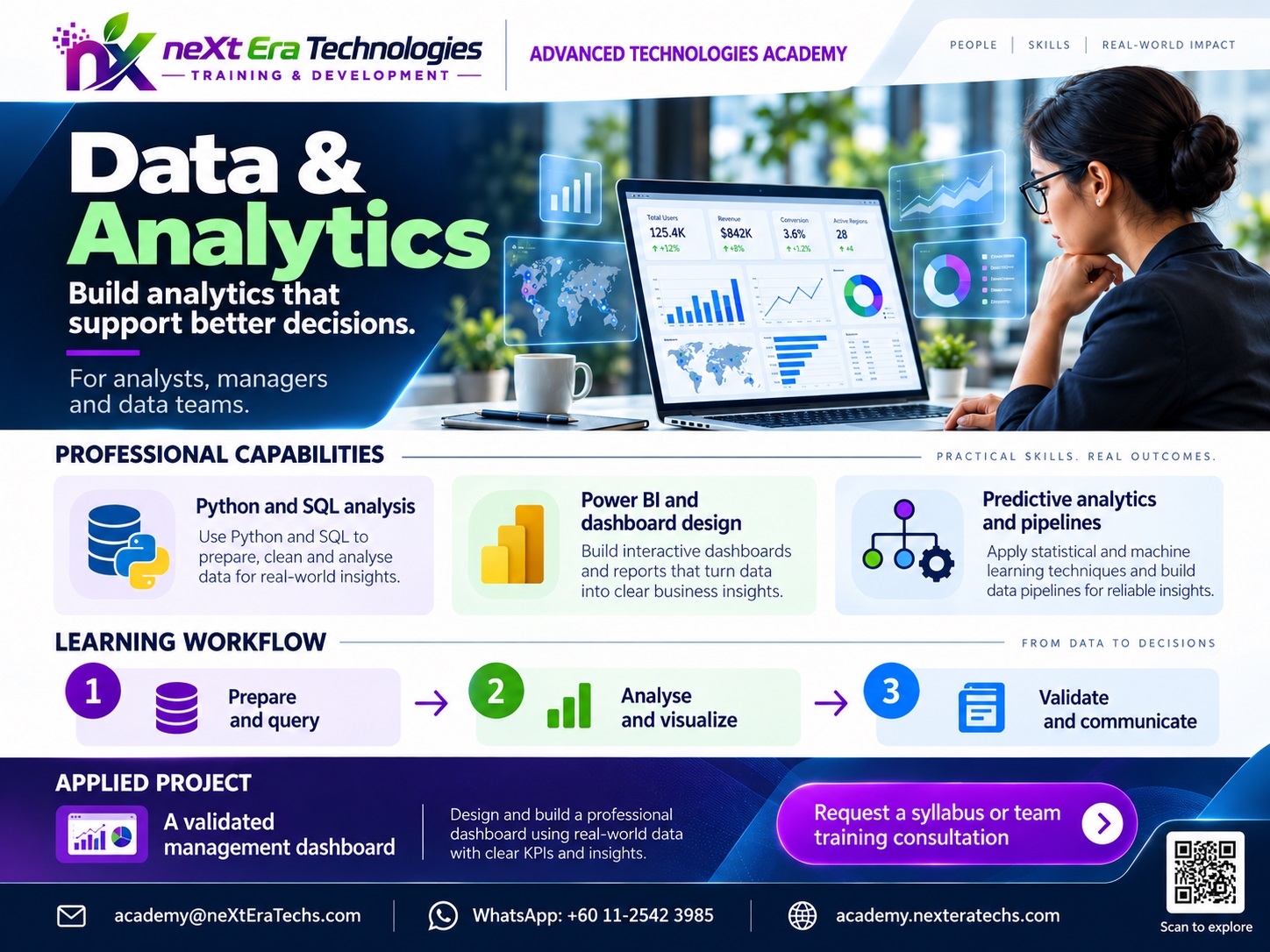
Data & Analytics

Natural-language interfaces for data and analytical systems.

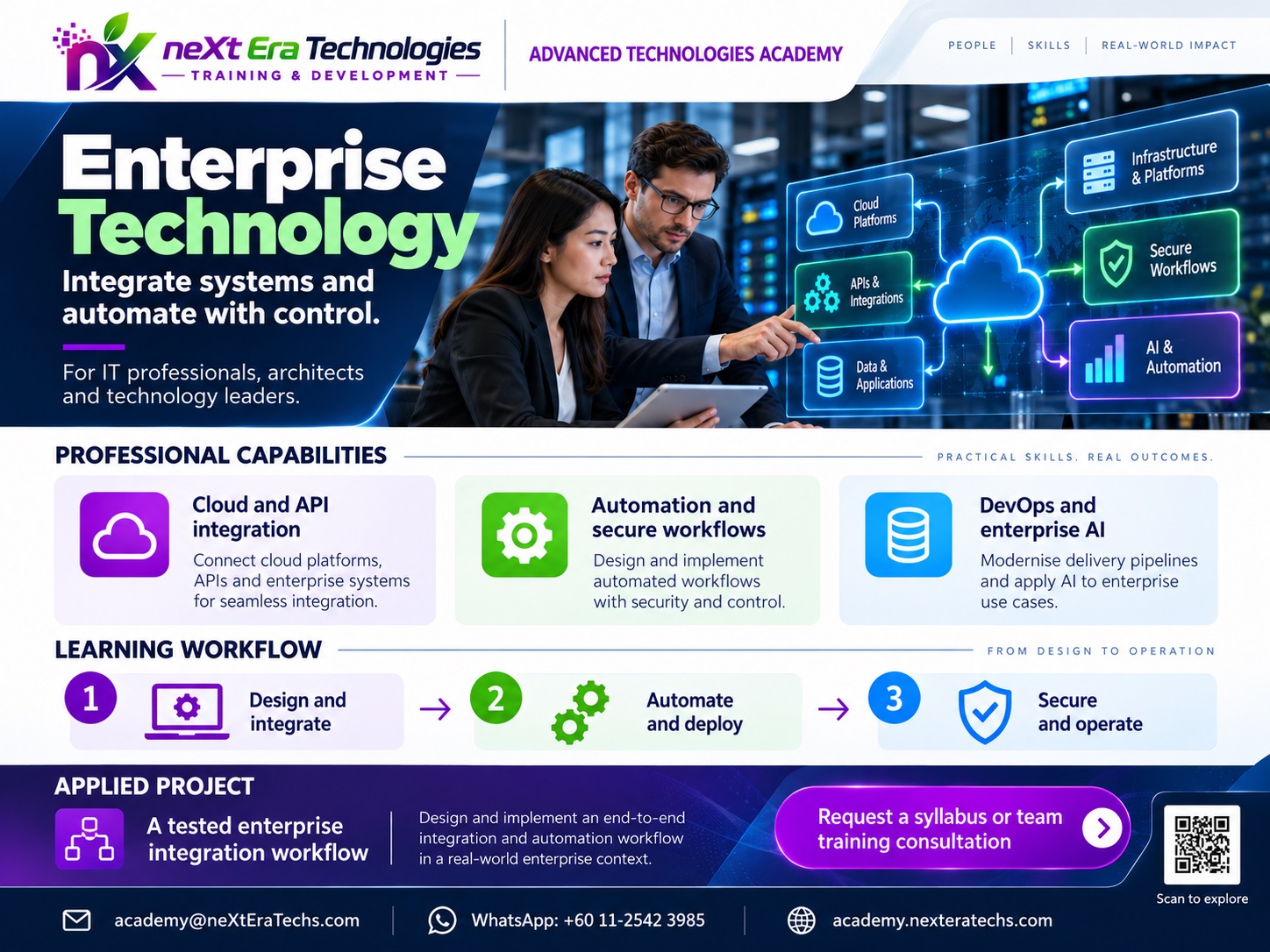
Enterprise Technology

AI integration with business applications, APIs and databases.

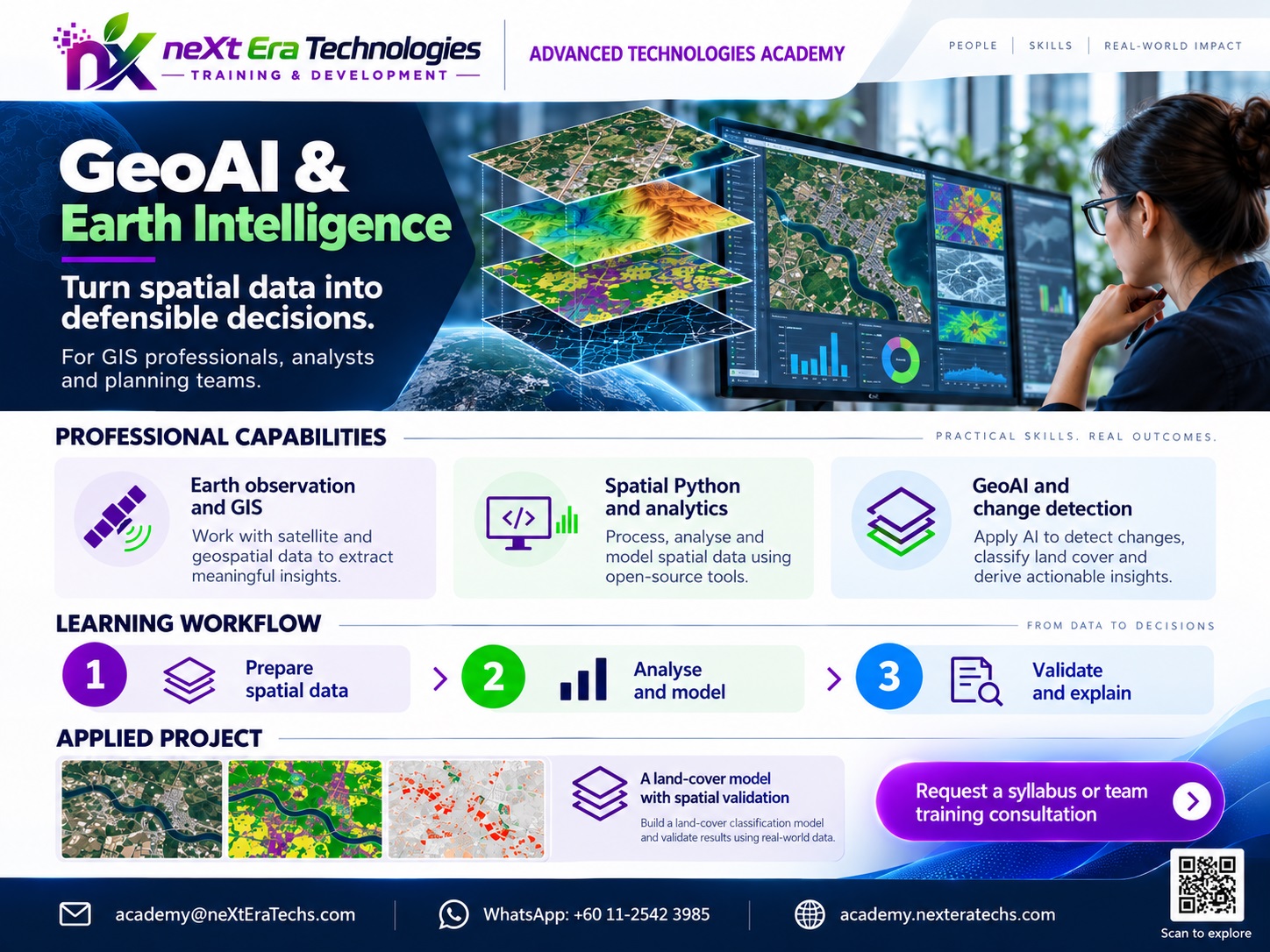
Climate & Earth Intelligence

AI-supported environmental monitoring, analysis and decision systems.

Final Project

Build Your Own AI System

Students finish the learning journey by defining a real problem and designing a working AI solution.

  • Problem definition
  • System architecture
  • AI component design
  • Data and retrieval strategy
  • Tools and API integration
  • Evaluation and test cases
  • Security and system boundaries
  • Working prototype demonstration
CAPSTONE PROJECT

From Problem to Prototype

Students document the problem, architecture, data sources, AI components, tools, evaluation strategy and system boundaries before presenting their working prototype.

Ask About the Program
neXt Era Technologies Training & Development

Learn. Build. Apply.

Practical learning for the next generation of technology professionals.

01

Learn

Understand the technology and principles behind modern AI systems.

02

Build

Apply knowledge through practical projects and technical exercises.

03

Apply

Use technology to solve real problems across business, science, education and society.

Build the Skills to Shape the Next Era of AI

Explore practical technology learning designed around modern AI systems, agentic workflows and real-world applications.