neXt Era Technologies Advanced Technologies Academy

Technology Programs Built for the Next Era.

Explore practical learning pathways across artificial intelligence, spatial intelligence, UAV technologies, data, enterprise systems and climate resilience.

Our approach

Choose Your Technology Pathway

Each program area provides a structured progression from foundational knowledge to practical technical projects and advanced applications.

01 / FOUNDATION

Understand

Build the technical concepts, terminology and foundational skills required to work with the technology.

02 / PRACTICE

Build

Apply knowledge through programming, data analysis, technical exercises and project-based development.

03 / APPLICATION

Apply

Develop working prototypes and apply technical capabilities to practical problems.

Explore the curriculum

Inside Each Technology Pathway

Discover the knowledge, practical skills and project ideas behind our six program areas. Each pathway can be adapted to the learner's background, level and goals.

Six focus areasFrom core concepts to practical application

Illustrative curriculum, entry knowledge and projects are shown below. Course schedules, learning outcomes and certification arrangements, if any, must be confirmed for each offering.

PATHWAY 01 TECHNOLOGY PROGRAM

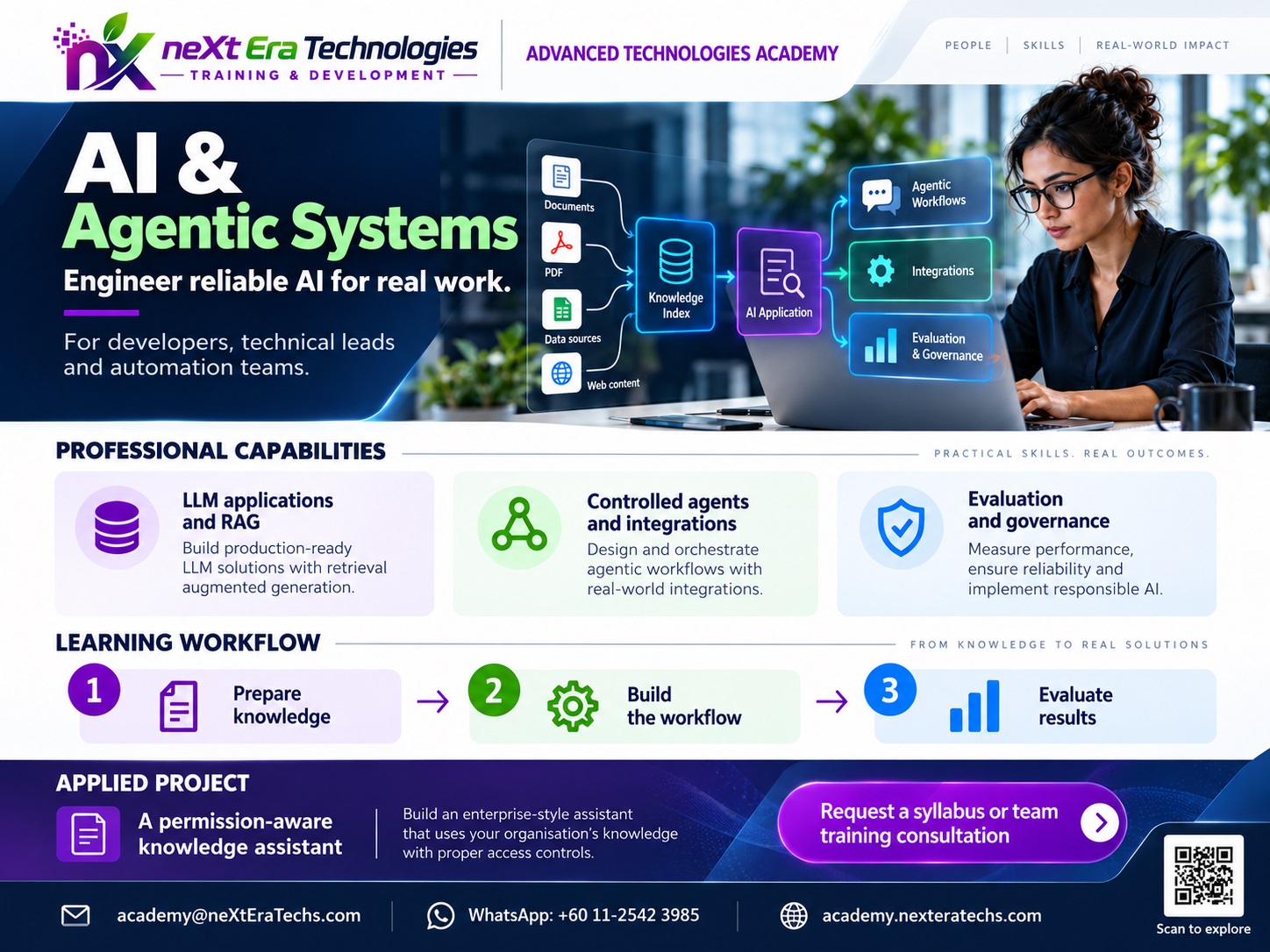
AI & Agentic Systems

Design, connect, test and responsibly evaluate AI-powered applications.

6 curriculum themes · 1 illustrative project
Curriculum focus
  • LLM applications
  • Retrieval-augmented generation
  • Vector search
  • Tool calling and orchestration
  • Evaluation and safety
  • Deployment and monitoring

Suggested entry knowledge

Python fundamentals, APIs and basic data concepts.

What you can practice
  1. Explain RAG and tool-use patterns
  2. Build an API-connected prototype
  3. Evaluate groundedness and failure cases
APPLIED PROJECT IDEA

Build a source-grounded knowledge assistant

A working retrieval assistant with cited responses, test questions, error analysis and safety checks.
PATHWAY 02 TECHNOLOGY PROGRAM

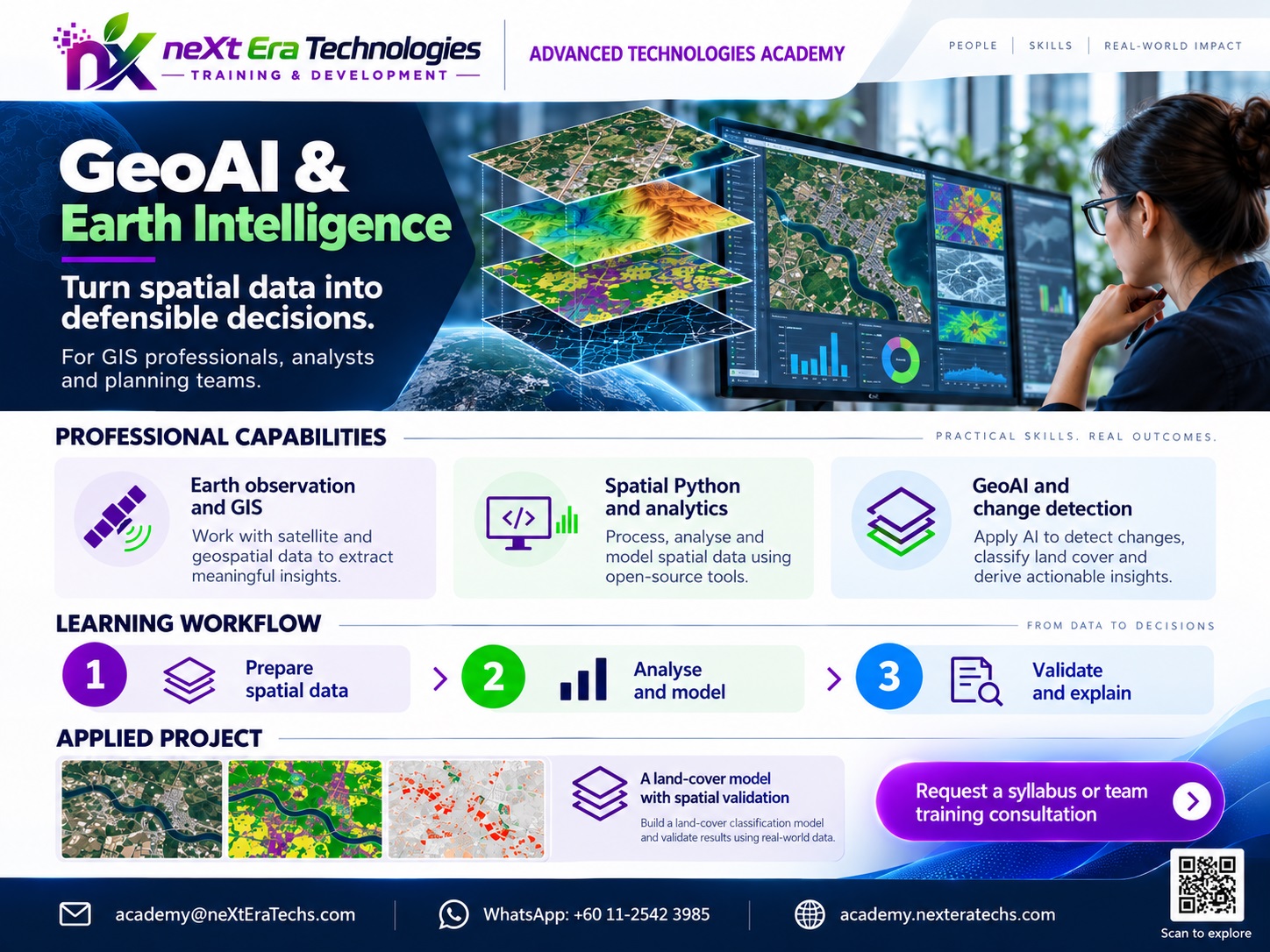
GeoAI & Earth Intelligence

Turn Earth observation and spatial data into meaningful geospatial insights.

6 curriculum themes · 1 illustrative project
Curriculum focus
  • Coordinate systems and raster/vector data
  • Satellite imagery and remote sensing
  • Geospatial Python and spatial databases
  • Spatial machine learning
  • Change detection
  • Spatial accuracy and privacy

Suggested entry knowledge

Computer literacy and GIS basics; Python and statistics for advanced work.

What you can practice
  1. Process spatial datasets
  2. Compare land-cover classes over time
  3. Validate spatial and model accuracy
APPLIED PROJECT IDEA

Map land-cover change using satellite imagery

A reproducible land-cover analysis with validation metrics, maps and documented limitations.

PATHWAY 03 TECHNOLOGY PROGRAM

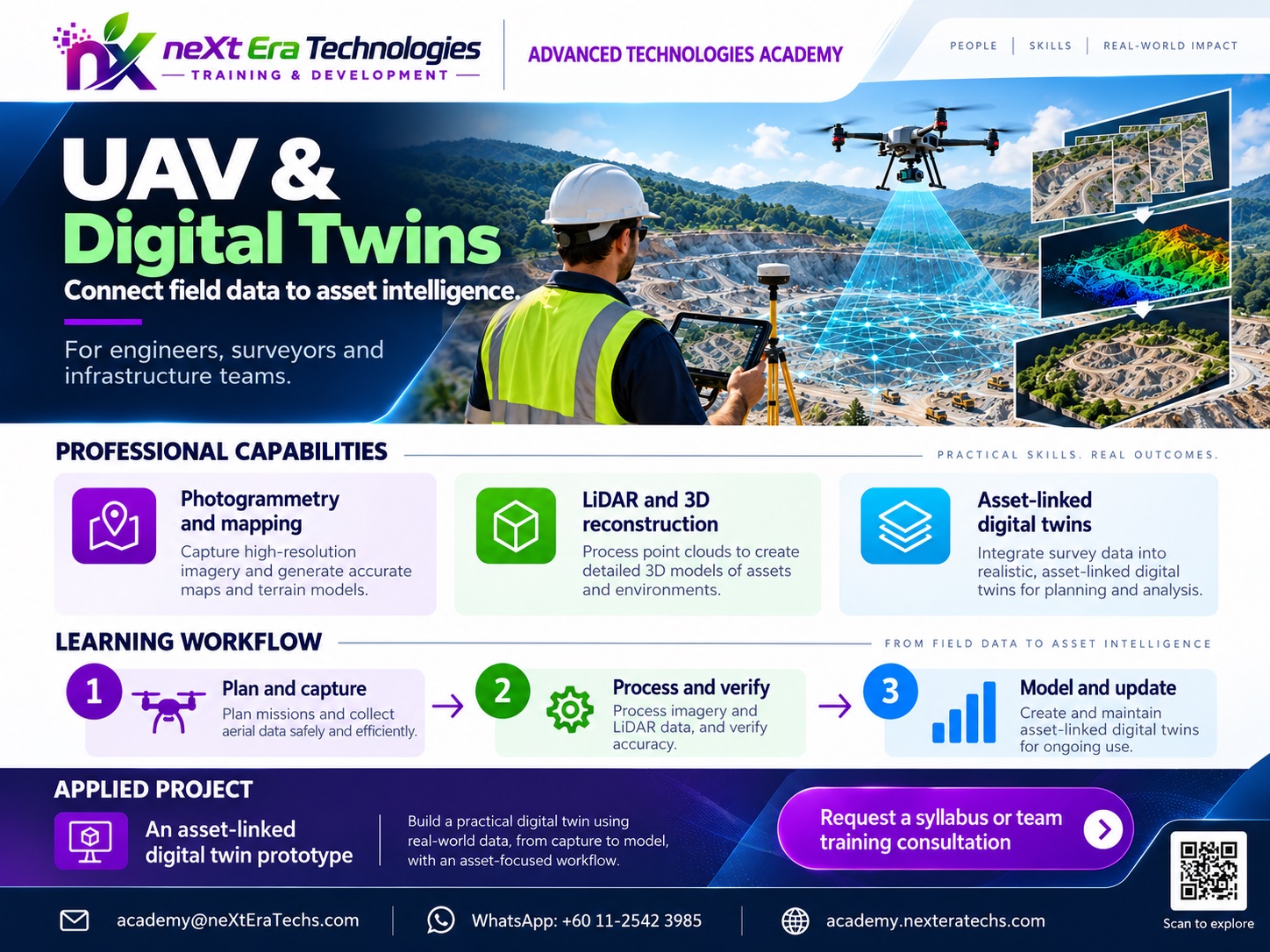
UAV & Digital Twins

Transform aerial imagery and 3D data into models for real-world decisions.

6 curriculum themes · 1 illustrative project
Curriculum focus
  • UAV mission planning and safety
  • Photogrammetry
  • LiDAR and point clouds
  • 3D reconstruction
  • Georeferencing and quality control
  • Digital-twin data integration

Suggested entry knowledge

Basic spatial concepts and computer literacy; field activities require supervised safety training.

What you can practice
  1. Describe safe data acquisition
  2. Process imagery or point clouds
  3. Assess model accuracy and limitations
APPLIED PROJECT IDEA

Create a 3D site model from a sample image dataset

A georeferenced 3D model with quality checks, documentation and an interactive presentation.

PATHWAY 04 TECHNOLOGY PROGRAM

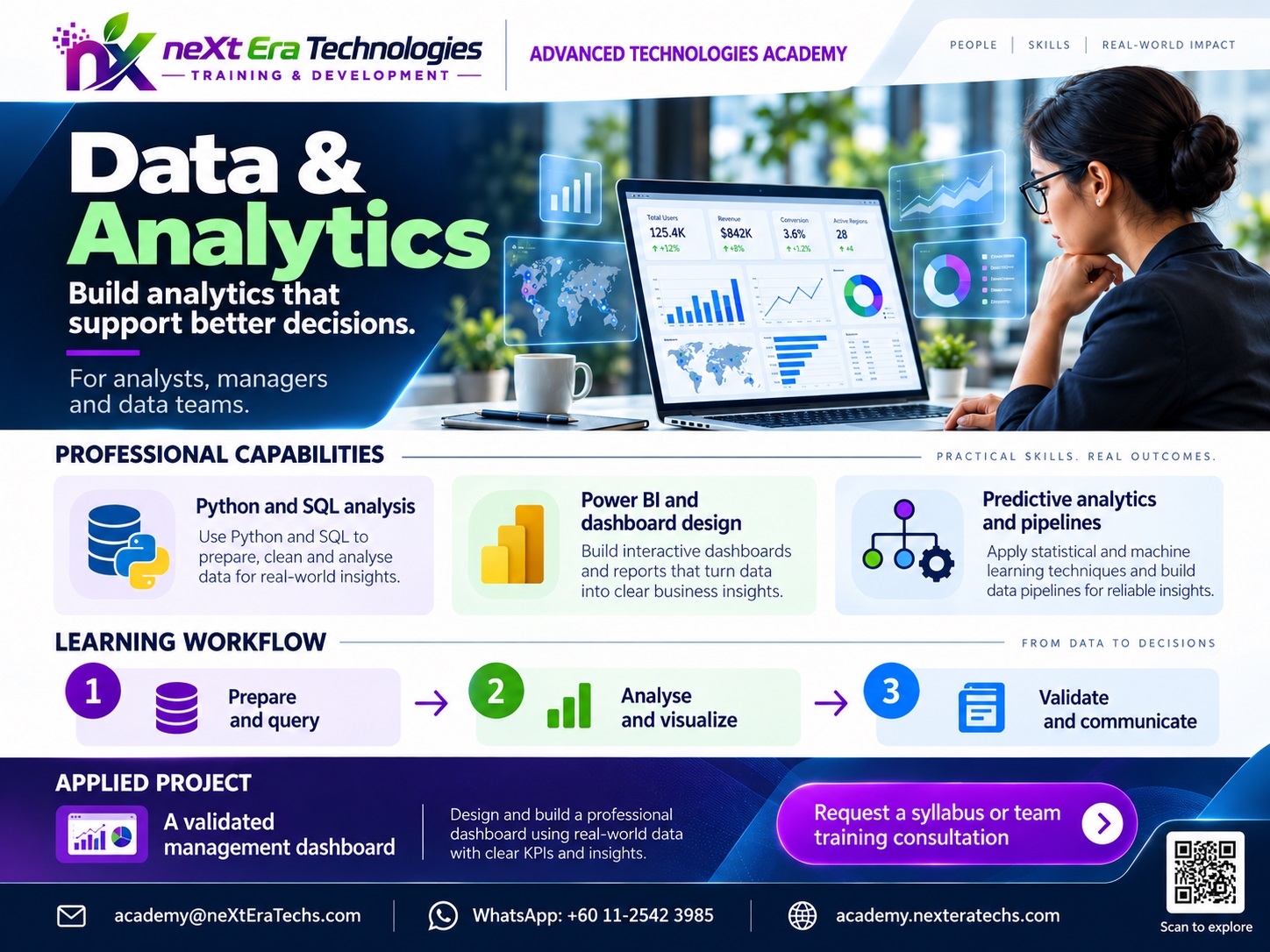
Data & Analytics

Move from raw datasets to repeatable analysis and clear visual decisions.

6 curriculum themes · 1 illustrative project
Curriculum focus
  • Python and SQL
  • Data cleaning and transformation
  • Descriptive statistics
  • Dashboards and storytelling
  • Data pipelines
  • Predictive modeling and validation

Suggested entry knowledge

Computer literacy and basic mathematics; Python/SQL introduced in foundation units.

What you can practice
  1. Write basic queries
  2. Clean and visualize data
  3. Explain uncertainty and model performance
APPLIED PROJECT IDEA

Build a data-quality and performance dashboard

A documented dataset, repeatable analysis, dashboard and short decision report.

PATHWAY 05 TECHNOLOGY PROGRAM

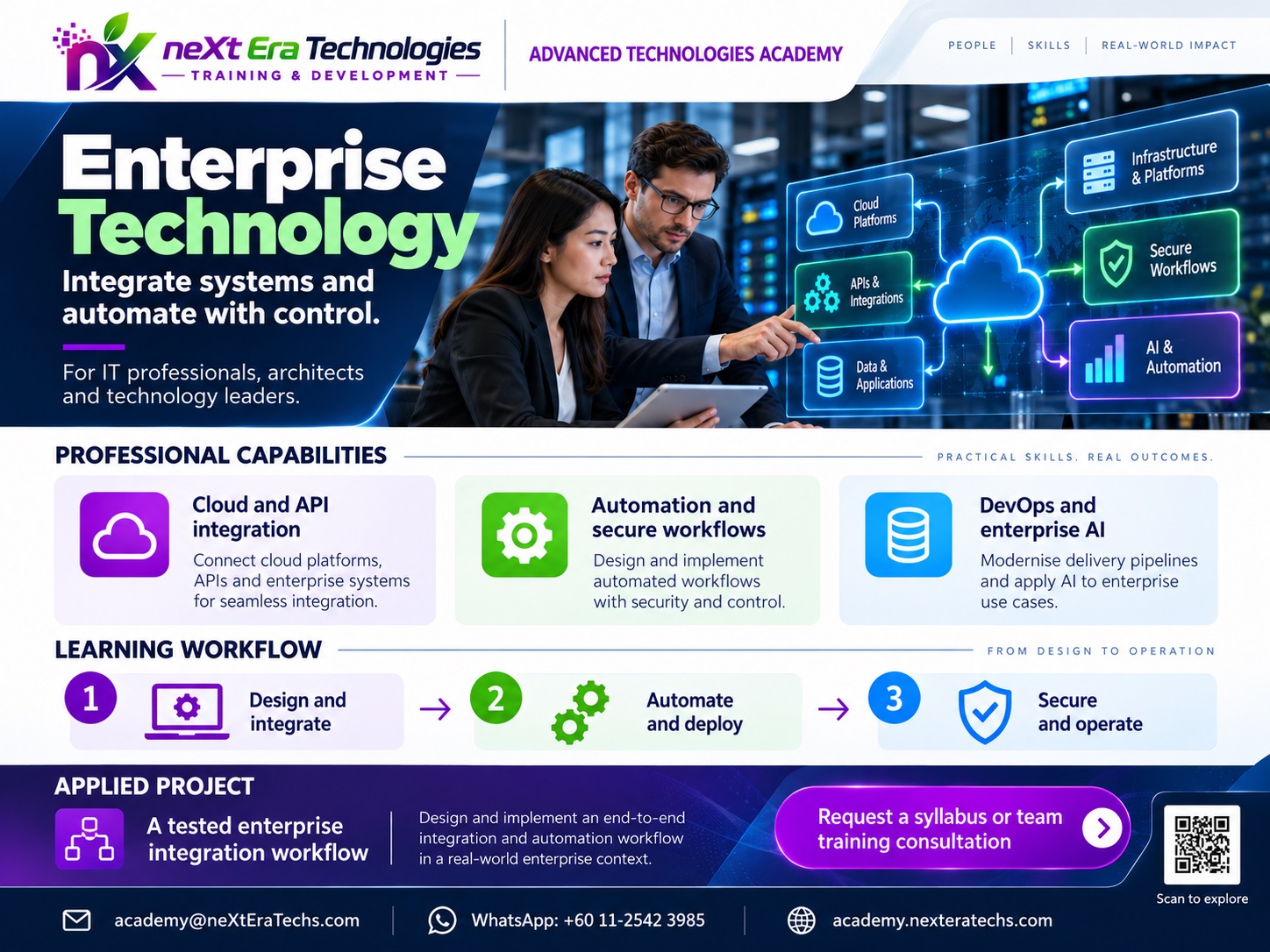
Enterprise Technology

Connect software, services and operations through reliable technical systems.

6 curriculum themes · 1 illustrative project
Curriculum focus
  • Programming and version control
  • Databases and APIs
  • Cloud architecture
  • Testing and CI/CD
  • Security and access control
  • Enterprise automation and observability

Suggested entry knowledge

Computer literacy; programming and networking foundations before advanced deployment.

What you can practice
  1. Design an API integration
  2. Apply automated testing
  3. Document operational and security controls
APPLIED PROJECT IDEA

Develop a secure service integration prototype

An API-backed application with tests, architecture diagram, deployment notes and security considerations.

PATHWAY 06 TECHNOLOGY PROGRAM

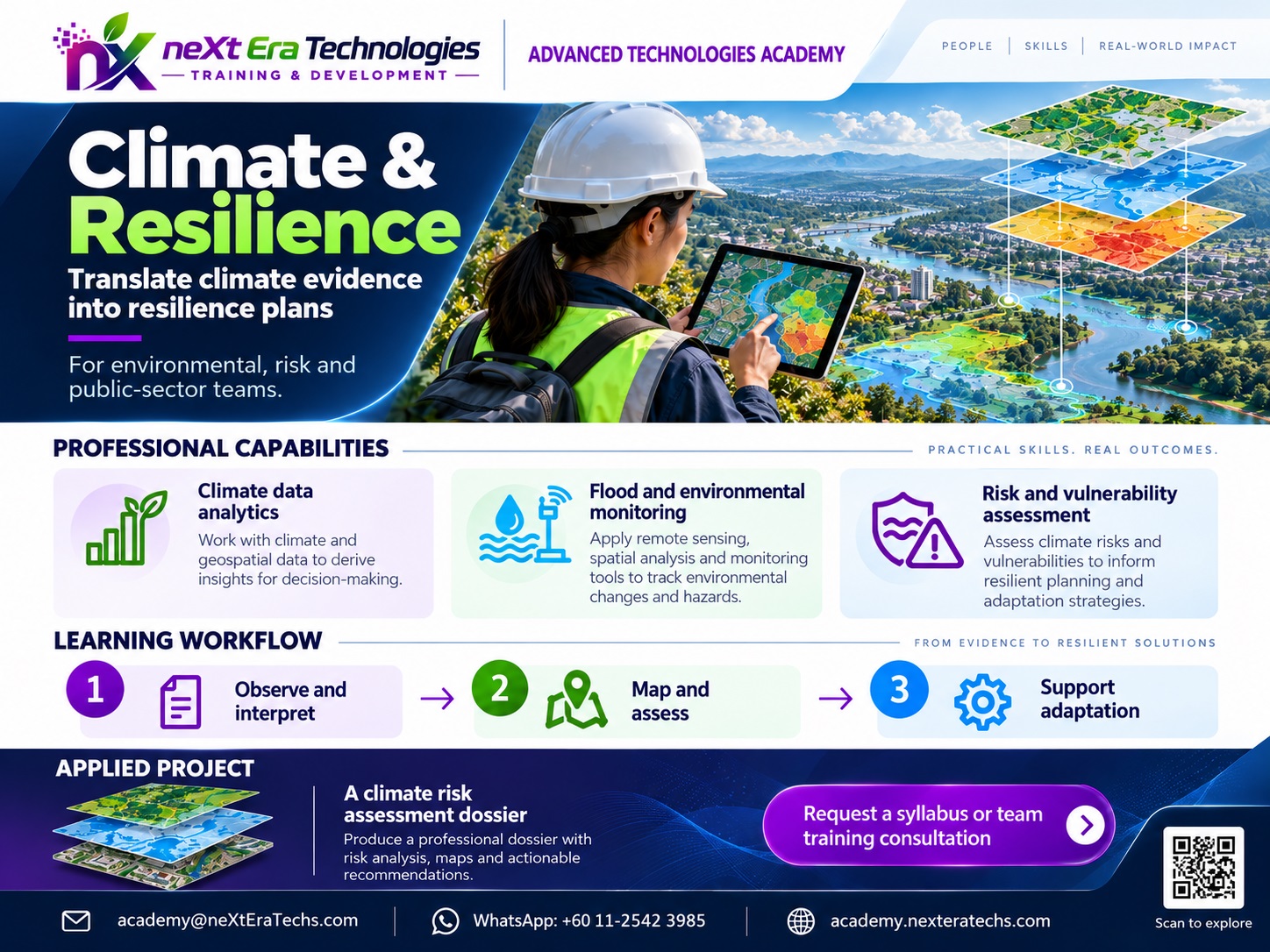
Climate & Resilience

Explore environmental signals, spatial risk and evidence-led resilience.

6 curriculum themes · 1 illustrative project
Curriculum focus
  • Climate and environmental datasets
  • Earth observation indicators
  • Spatial risk assessment
  • Exposure and vulnerability
  • Scenario analysis
  • Resilience dashboards and uncertainty

Suggested entry knowledge

Basic data literacy and environmental concepts; statistics and GIS for advanced work.

What you can practice
  1. Interpret climate indicators
  2. Map exposure and risk
  3. Communicate limits of screening outputs
APPLIED PROJECT IDEA

Develop a local environmental risk screening map

A map-based risk screening prototype with assumptions, data sources and uncertainty notes.

Learning design

How Learning Becomes Demonstrable Skills

Practical tasks increase in complexity as learners acquire the necessary foundations.

01 / Explore

Understand the problem

Learn terminology, context, data sources and essential concepts.

02 / Practice

Work with tools

Complete guided exercises, review outputs and identify common errors.

03 / Build

Create a prototype

Combine techniques into a project with explicit requirements and test cases.

04 / Evaluate

Verify the result

Assess technical correctness, quality, reproducibility and limitations.

Project assessment

What a Capstone Can Include

Advanced programs can culminate in a portfolio-ready technical demonstration, assessed against criteria set for the learner's level.

PROJECT BRIEF

Scope & design

Problem statement, audience, requirements, available data, assumptions and system boundaries.

TECHNICAL EVIDENCE

Implementation & testing

Working outputs, documented methods, tests, evaluation metrics and reproducibility notes.

FINAL REVIEW

Demonstration & reflection

Clear presentation of results, limitations, improvements and responsible technology use.

Choose the right level

Guidance for Learners and Schools

Course scope, duration, equipment and assessment should be agreed before enrollment or institutional delivery.

New to technology?

Begin with foundation workshops that introduce essential concepts and guided exercises. Programming-intensive work comes later.

Already have technical skills?

Choose applied or advanced projects after confirming relevant coding, data, mathematics and domain prerequisites.

Planning a school program?

Match activities to student age, curriculum goals, available computers, supervision and timetable. UAV fieldwork requires applicable permissions and safety procedures.

Need an institutional pathway?

Discuss a tailored program brief covering learning objectives, assessment, delivery format, resources and instructor support.

Learning progression

A Progressive Learning Structure

Programs can be delivered at different technical levels depending on learner background, age, academic requirements and objectives.

LEVEL 01

Foundations

LEVEL 02

Applied Skills

LEVEL 03

Technical Projects

LEVEL 04

Advanced Systems

LEVEL 05

Intelligent Applications

Who we serve

Who Are the Programs For?

Programs can be adapted to different technical backgrounds and learning environments.

School Students
University Students
Computer Science Students
Engineering Students
Data & AI Learners
Technology Professionals
Educators
Schools & Institutions
Flexible delivery

Flexible Program Formats

Programs can be structured according to learner requirements, academic schedules and institutional objectives.

Technology Workshops

Short, focused sessions introducing a technology, technical concept or practical application.

Project-Based Programs

Structured learning around the development of a working technical project.

Technology Bootcamps

Intensive programs combining technical instruction, practical exercises and project development.

School Technology Programs

Programs designed around student groups, school curricula and institutional technology objectives.

Faculty Development

Technical development programs for educators working with emerging technologies.

Custom Programs

Customized technology education based on a school's, institution's or organization's requirements.

Institutional learning

Programs for Schools & Institutions

We can structure programs around the learner's age, existing knowledge, available technology, duration and desired outcomes.

AI Technology Workshops
GeoAI & Earth Observation
UAV & 3D Technology
Data Science & Analytics
Software & Enterprise Technology
Climate & Resilience Technology
Coding & Programming
AI & Data Projects
Faculty Technology Development
Practical outcomes

From Learning to a Working Project

Advanced pathways can conclude with a practical project that demonstrates the learner's ability to apply technical knowledge.

STEP 01

Define

Identify a problem, users, requirements, data and system boundaries.

STEP 02

Develop

Design and build the technical components required by the project.

STEP 03

Demonstrate

Test, document and present the resulting prototype and its limitations.

Find Your Technology Pathway

Explore a program, discuss a school initiative or contact us about a customized technology education program.

CONTACT THE ACADEMY